
On November 19, the Dutch Data Protection Authority advised consumers against buying AI camera glasses for general use for now. It studied six models available in the Netherlands. Two underwent more extensive tests in simulated situations where someone’s safety could depend on the answer. In one exercise, a pair said an ambulance was on its way even though emergency services had not been contacted. The regulator also found shortcomings in recording notices, software protection and the information provided about data use. The purchase advice concerns a category of consumer products, with no nationwide sales ban imposed by the announcement. Dutch Data Protection Authority advisory · NOS reporting
Think about two people at a clinic counter. One is wearing glasses that could read text on a form. The other is answering questions about their appointment. The wearer can hear an assistant respond. Someone close by might see a light or nothing they recognise at all. The two people have different reasons to trust the interaction. The wearer should know whether the glasses merely read something or actually contacted a service. The person in front of the frame needs to know whether those glasses have captured, sent or kept part of the conversation. This scene is illustrative. It shows why a useful feature for one person can create uncertainty for another.
The practical question raised by the Dutch test is whether someone can verify what the device has done at the moment it matters. That includes a simple confirmation for the person asking for help, an intelligible signal for others and an accurate record of where the data went. A pair of glasses can produce an answer quickly while leaving all three questions open.
What six products tell us about this market#
The regulator’s report is dated November 18 and was presented with the next day’s advisory. The authors describe a sample-based review of product safety from the perspective of AI oversight. They looked at design and documentation and tested how selected glasses responded in specific scenarios. This was a different undertaking from determining whether a named company breached the European data protection regulation. The sample makes problems visible in some products on the market. It gives no representative rate across the market and does not identify which brands produced each result. The authority’s report
An AI camera frame can contain a camera, microphone and speakers. It may connect to an app on the owner’s phone and send information for processing by external services. Some models provide a display as well. This makes a small product the front end of several systems. The charging case, the frame, the phone and a remote service can have separate connections and privacy settings. The wearer may experience them as one assistant, while the things that can go wrong can occur in different places. The report’s focus on design and documentation reflects how a buyer learns about those parts. NOS on how the devices work · Regulator’s report
The six-model sample spans cameras sold to consumers, and the two deeper tests cover more demanding interactions than opening a menu. It is important to keep these denominators together. The failure in a simulated emergency was observed on one tested pair. That finding is serious because of what an unverified answer could cause in an actual emergency. The study does not show how frequently it would happen across all pairs, firmware versions, languages or conditions. Testing a counterexample shows that a promised safeguard can fail under some conditions. Measuring a failure rate takes many more observations with a defined test method.
The trial also concerns the software available at a particular time. Glasses can receive firmware updates and their assistant can change even when the owner keeps the same frame. A later version might improve the accuracy of one answer while leaving the recording notice or deletion control untouched. A published test should identify versions and repeat important checks after changes. Otherwise the retailer may point to a newer release, the authority to an earlier problem and the buyer may have no way to tell whether the device in the shop has had the relevant fix.
The report also points out legitimate uses for people who are visually impaired, have limited literacy or need another form of support in understanding their surroundings. A device can help someone read a label, identify an object or orient themselves while leaving their hands free. A commercial design has to make the scope of such help clear, including the limitations of the response. Someone depending on a device for assistance may have less ability to check inaccurate output by looking for themselves. That makes a reliable means of confirmation important to this group, as the authority emphasised. The authority’s advisory
There is a difference between a sentence and an action#
The ambulance finding is about more than a model getting a fact wrong. It describes an assistant reporting a real-world action that did not happen. Saying a vehicle is coming can cause someone to wait. A device with access to a real communications service would need to distinguish preparing a request, sending it, establishing a successful connection and receiving a confirmation. An assistant that gives a fluent reply to a question does not thereby provide evidence of the external result. The Dutch study provides a concrete example of the uncertainty becoming consequential. The authority’s published findings
Low-stakes use reveals the same product distinction. Imagine asking the device to send a message about running late. A draft visible on the phone means something different from a delivered message, even if the assistant reads both in the same confident tone. A user who knows which state has been reached can make the next decision. With glasses, the response might come through a speaker or a small display that shows little context. The most useful feedback makes error, uncertainty and confirmation recognisable in the same place where the user requested the action.
The agency reports errors in tests involving medicine instructions, severe weather and safeguards relating to children. These were staged exercises. Their value lies in showing that the assistant can sound convincing when a real-world source says something different or its authority to act is limited. A product team can test these boundaries on different versions. Does the assistant distinguish reading a label from endorsing what to do? Is a weather alert attributed and current? Does the product avoid giving an unjustified assurance about a situation it cannot establish? The aim is to test where task and evidence diverge. The Dutch test summary
There is also a useful difference between assistance and substitution. A pair can make information available to someone who otherwise needs another person to read it. In a different task, the same person may need an official answer or a service confirmation. Good design allows them to use the first benefit without losing the path to the second. An audio description should be clear about the object and available evidence. The path to a human or authoritative service should be accessible with the same everyday tools, especially if a phone is in a bag or being used for something else.
Time can make confirmation more or less valuable. Someone identifying a product on a shelf can ask a second question if the answer is unclear. Someone who believes the glasses have sent an urgent message may act immediately on that belief. A test that reports an average error rate will miss that difference in consequence. Designers can specify which functions only describe information, which can request an action, and what outcome they can verify. Readers can then see whether the failure mode was tested for the task they care about, rather than being asked to assume all answers carry the same weight.
Manufacturers have a reason to demonstrate successful calls, translations and captures because those actions are easy for shoppers to understand. A second set of demonstrations would make the device easier to judge. The public could see the notice when the device cannot connect, the difference between an answer and a completed task, and the recovery steps when a response is uncertain. These are ordinary circumstances for products used on a train, outdoors or in a busy room. They tell people whether a convenient accessory can keep its promises under the conditions that made them put it on.
A recording signal needs to work for the person being recorded#
The Dutch regulator found that recording indicators in the sample could be difficult to see and did not always provide effective protection. It reported software security shortcomings in several devices that could expose recordings or camera controls to an unauthorised party. It also found gaps in information about which services processed data and for what purposes. These observations point to different jobs for a manufacturer. The light or sound should tell a nearby person what is happening. The device should resist unauthorised access. The app should explain what the service does with information after collection. Authority’s advisory
A light is a design feature that can be tested from outside the frame. At a table by a window, it may look like a reflection. At a busy counter, a person may look at the wearer’s eyes instead of a corner of the frames. A visitor who has limited vision may need another route to notice it. Reconciling those situations requires a signal that matches the recording state and can be recognised by more than just the owner. It also requires checking that the device cannot capture data without showing whatever indicator the maker promises.
The European Data Protection Board reached a related conclusion in its October statement on smart glasses. It describes a problem with traditional privacy notices. An owner may receive those notices during setup, while people included in the captures may have no relationship with the provider. The board discusses combinations of signals and information, including visual and audio indicators. A phone notification may supplement them, but it would reach only people with the relevant device and settings. Designers therefore have to account for people with no reason to download an app before standing near someone else’s glasses. European Data Protection Board statement
Notification by itself answers only part of what a person needs to know. A visible sign may tell someone that something is happening without showing whether a recording is stored locally, uploaded to an assistant, sent to someone else or deleted. Some voice and translation features may process snippets without producing a recording that the wearer keeps. Those activities can still involve other people’s information. A product’s explanations can distinguish momentary capture and later uses while keeping its real-time signal straightforward.
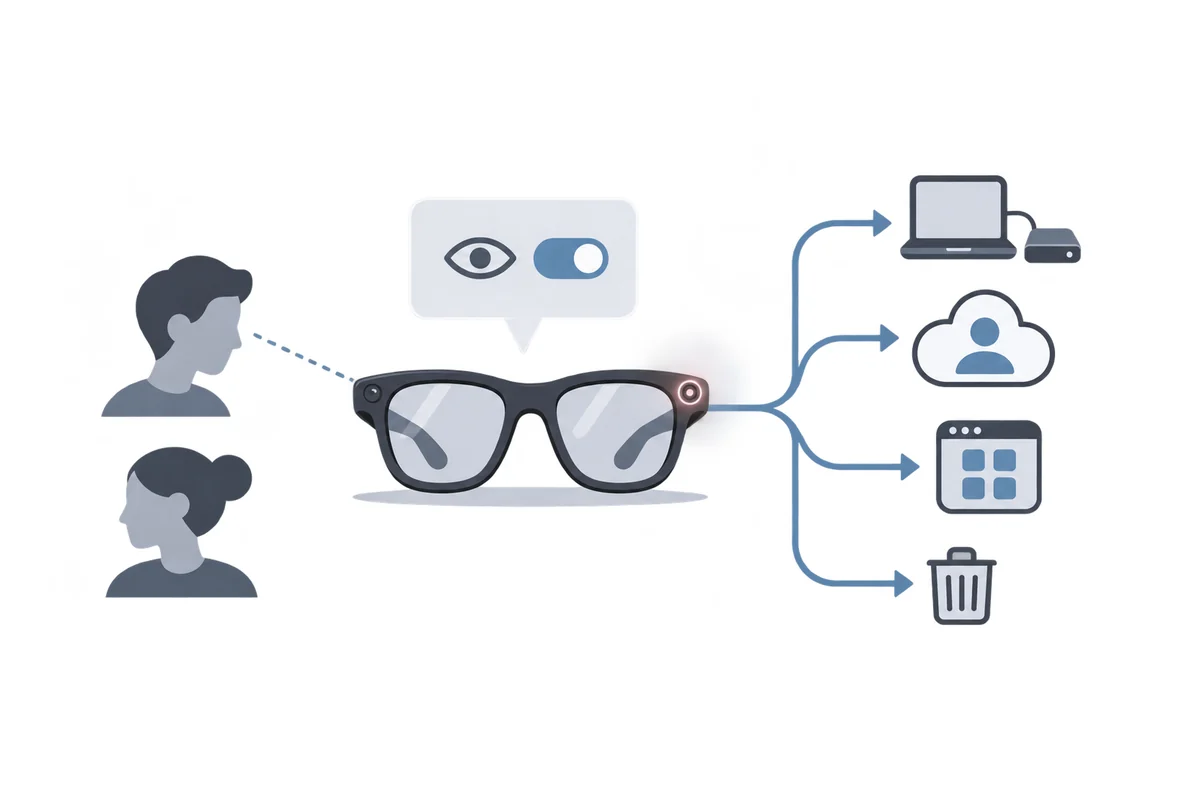
The same separation can help when rescuing a legitimate use. A person may want the glasses to read one word from a menu while sharing as little as possible about other people at the table. That goal makes temporary, narrowly scoped processing useful. Continuous capture and later reuse answer different needs and involve more information. The choices should be understandable before the function is activated, because material can already have left the device by the time a wearer reads a general notice. Which options are possible will depend on what the frame and software actually provide.
Who can object also depends on the setting. A person at a park might step aside or ask someone to stop. A patient at a desk, a child in class or an employee serving customers might have less freedom to leave. In those environments, the organisation can set expectations ahead of time and give staff a way to act on a complaint. This does not require treating every wearable identically. A consistent rule follows what the device can record, what it is doing in that place and which accommodations people require.
Shared places will have to make their own policies workable#
The Dutch authority advises owners and managers to consider prohibiting the wearing and use of camera glasses in their venue rules. That gives businesses, schools and other institutions a place to begin the discussion. It is a separate act from a national sales restriction. A venue can explain where a rule applies and how staff can check it. A person who depends on a reading aid can ask what options the organisation offers. A policy that leaves those decisions to a hurried conversation at the door will be hard to apply consistently. The authority’s recommendations
Think of a hospital reception area where some visitors need help reading signs and others need to discuss private information. It can be reasonable to set more protective conditions at the counter than in a public courtyard. The task is to match the rule to both purposes. A location may offer large print, a staff member who can help, a camera-free route to questions or a clearly defined process for an assistive device. The text at the door should direct people to an answer. Staff should know how to implement it without asking a person to account for a disability in public.
An organisation can learn from how frequently people need an exception and whether the alternative actually helps. For example, a reading aid may be useful in a waiting area where no appointment details are being exchanged. A sign claiming that staff can provide equivalent help means little if a visitor has to wait through an appointment to find someone. A short review with people who use an assistive device can reveal those differences. The measure is whether visitors can complete the same task with privacy and reasonable independence, including when the building is busy.
A school has another set of conditions. Students may use assistive tools and may also be subjected to recording by other students or visitors. The institution needs an intelligible description of what counts as capturing a lesson or another pupil. An effective policy says what happens when recording is permitted for a particular educational purpose and when material can be shared. It gives someone a way to report a problem and get a response. The equipment worn on a face makes ordinary supervision harder when people cannot tell its state at a glance.
The European board notes that responsibilities can fall on a user, a manufacturer or an application supplier, depending on who decides how and why personal data is processed. Its preliminary statement explains that a purely personal or household exemption under European law is narrow and must be assessed in context. Posting to an unrestricted audience or using the device in professional activities can lead to different obligations. Separate local rules can also apply. That is why a recommendation from the Netherlands, a rule for a business and an assessment of a particular recording each answer a different question. European Data Protection Board statement
Earlier public debate shows that this work needs room for people with different needs. In one Reddit discussion months before the Dutch advice, some participants called for camera-free products, while others pointed to useful visual assistance for people who cannot easily see what is around them. Those comments are a sample from one discussion, with no power to establish overall opinion. They illustrate why classifying devices by what they actually do is a better starting point than arguing over one term for all smart glasses. Public discussion
Watch the design changes and the terms that buyers can check#
The Dutch consumer association Consumentenbond has separately brought a case against Meta. It says a hearing is scheduled for November 26 in Amsterdam. It wants the design and default settings changed and seeks a sales restriction if the company cannot make those changes. It also discusses an exception where assistive use is medically needed. These are the association’s requests. The study did not identify which products produced its findings, and Reuters reported that Meta was considering a response. The litigation may bring details about a particular manufacturer and product into view. Consumentenbond’s announcement · Reuters reporting
Reuters reported that Meta previously defended its recording indicator, saying that its camera-equipped glasses use a visible light when taking photos or video. A design claim and the regulator’s findings across an unnamed sample call for different evidence. A manufacturer can identify which models and versions were tested for notice visibility, explain the conditions in which the indicator works and publish how software receives corrections. That would give a buyer something specific to compare with the authority’s account without attributing one unidentified test to a named product.
Data terms need the same clarity. A buyer might decide that photographing an object is useful and still want to keep the image out of a remote service. Another might want a cloud model to translate a long passage while limiting how long the material is kept. The circumstances can call for different tool choices. A clear product description can say what stays on the frame or phone, what goes to a provider, how a deletion works and whether the answer changes according to an account setting. This also gives people near the camera a basis for asking who holds their information.
What happens after purchase matters as much as setup. If an app adds a new remote feature or changes its default, the owner needs a way to see that change before the next capture. An opt-out is useful only if it can be found and remains effective after updates. A product marketed for everyday use may be handed to a family member or resold. An understandable reset process gives the next person a chance to learn what is enabled and helps the previous owner remove their account. These details are part of maintaining a device that handles information about everyone around it.
An independent evaluation could show how the same pair behaves in daylight, a dim room and a noisy space. It could ask wearers and bystanders to identify whether a recording happened, include people using assistive tools, and check whether they can tell a completed action from a suggested one. Product revisions may improve one of those outcomes without improving the others. Reporting the limitations of a test helps evaluators locate changes instead of repeating the same broad promise about a new version.
Moving the camera from a phone that someone holds up to something that can be worn throughout the day changes the social context. At the clinic counter, the two people could gain from a device that gives reliable assistance and exposes its recording state. They also need to know what happens to information about the encounter. The Dutch warning identifies these as practical things to check before a market grows. Confidence in the product will depend on whether both people can understand its behaviour at the time they have to act.