
On October 20, 2025, four teenagers were waiting outside Kenwood High School for a ride after football practice. One had a bag of chips. An automated camera-monitoring service flagged a possible firearm. School safety staff reviewed the alert and canceled it within about two minutes. The students were later detained by officers who approached with guns drawn, according to their lawsuit and reporting based on officers’ body cameras. No weapon was found. The immediate question is how a warning the school had already rejected could still lead to an armed confrontation. WMAR’s reporting · Maryland’s education inspector general report
The four students, some of whom have since left the school system, filed their civil suit in Baltimore County Circuit Court on November 17, 2026. They accuse the school district, county and police personnel, and software provider Omnilert of failures in the way the alert was generated, reviewed and acted upon. Their requests include damages and a court order barring the district and county from using such a system until they have adequate verification, cancellation and training procedures. These are claims and requests before the court. The filing gives families a specific question to ask now: what has to happen for a warning to lose its authority throughout the response? The students’ lawyers’ statement
For a child, the event begins with a normal evening and changes with a command from the police. In the school and vendor records, there are several decisions between those moments. A computer highlights something for review, a person evaluates it, someone changes its status, and someone else chooses a response. Looking at those decisions together helps explain why improving image recognition alone would leave a problem exposed. The cancellation has to change the decision at the end.
What happened after officials called off the alert#
The school district’s 2025 community update, cited by the ABA Journal, said an Omnilert alert went out at 7:04 p.m. and safety staff canceled it at 7:06 p.m. The update said the principal contacted a school resource officer later and the officer passed the report to the local precinct. The state inspector general found that staff sent a cancellation and that the warning process nonetheless continued outside the school’s internal control. The official sequence puts a canceled alert before the police response. The lawsuit asks the court to decide who bears responsibility for what happened in between. District timeline reported by the ABA Journal · Education inspector general report
The plaintiffs say school and police representatives determined early that the image showed no gun. The complaint alleges the principal later sent an image from the original alert to a school resource officer without making sure it was still active. The 2025 inspector’s account records a different emphasis. It says the principal was reviewing the image, did not see the cancellation, tried to contact a safety manager and contacted the school officer. The distinction matters. A warning that is deliberately overridden and a warning forwarded by someone who has missed a correction both require accountability, with different facts to establish. The plaintiffs’ account · The inspector’s account
According to WMAR, police and school officials declined to comment on the filing. Omnilert told the station it was sorry for what the students and their families experienced, said its service flags possible threats for human review, and described the school team’s cancellation within about two minutes. The company said it was reviewing the complaint and would respond in court. Its account explains where it sees a handoff between the product and local officials. It leaves questions about whether a recipient understood the latest status and how the software and school procedures communicated it. WMAR’s account and the company response
For the people using the warning, knowing the history of a message is different from knowing what action is appropriate now. A still image can survive when the warning that produced it has changed. Someone receiving only the image may have little basis for knowing whether another person has reviewed it, or whether the situation has been closed. Those holes in a decision record are especially important when the first report travels from school staff to an outside agency. The inspector’s investigation found that the school could no longer control the notification and response methods once law enforcement became involved. Inspector general findings
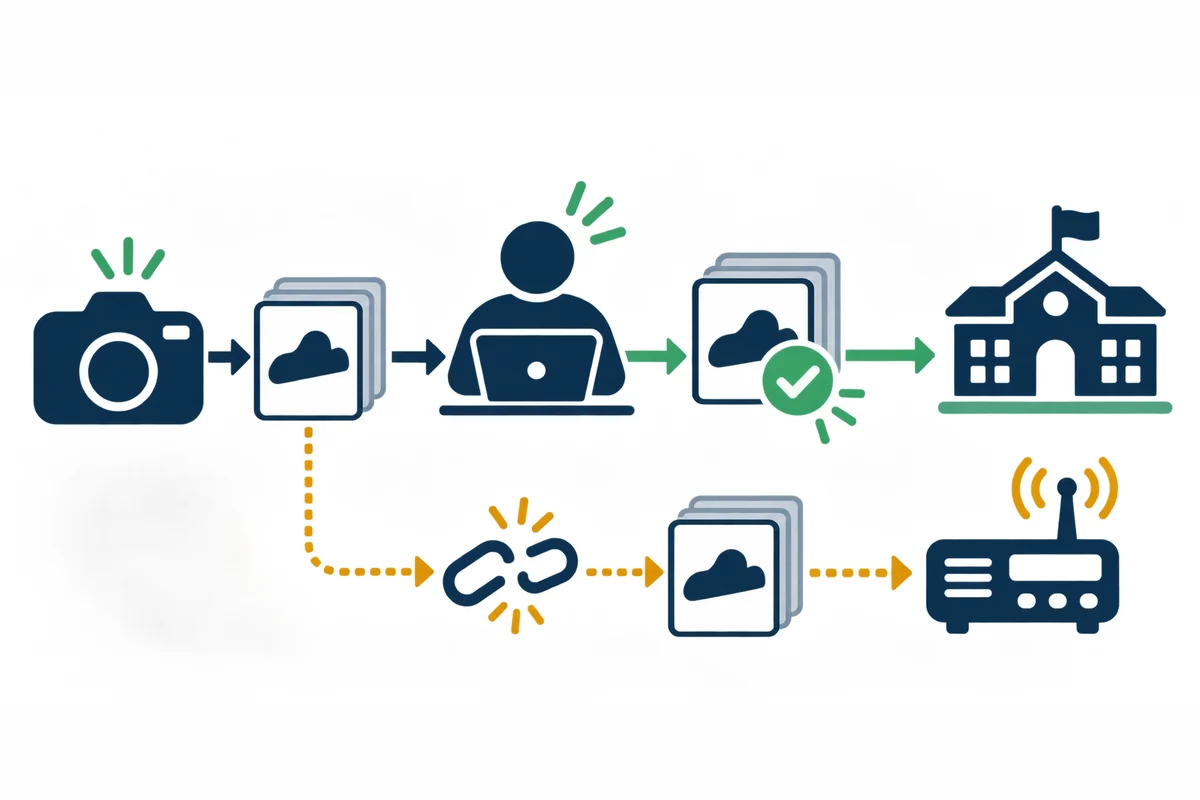
That leaves two layers of responsibility. The person handling a warning needs clear information and training. The agencies that share it must agree on who can confirm it, how they will act on a correction and who checks whether it has been received. Even a well-trained person can have incomplete information after a handoff. A written rule has practical value when the people relying on it use the same definition of the event’s status and can find that status when making a decision.
An after-hours event like Kenwood’s makes the assignment of those duties important. A district can decide ahead of time which office maintains the authoritative status and who can update it when the person normally responsible is away. The police department can have its own obligations once it has received a report. The agreements between the organisations need to explain how the records are reconciled, including when the people taking action work at different locations. Assigning one office to maintain the school’s record gives families a place to ask questions and gives other officials a verifiable account to consult.
A number on a screen cannot settle a question about a child#
The complaint refers to a 90 percent confidence score. A model’s score reflects how it ranks a possible classification. Interpreting that score as the real-world probability of a firearm being present would require a separate, relevant validation of how well the score is calibrated. The state inspector concluded the alert reflected a combination of the object and the student’s movement. The report’s account is narrower than a claim that every bag of chips looks like a firearm to the software. The result in this instance was still a false warning about an ordinary object. Students’ lawyers’ account · Inspector’s finding on the detected object
School camera footage includes equipment, tools, objects carried by students, and people moving under changing conditions. The ordinary activities of a school continue throughout its use of safety software. An evaluator has to ask what happens across those everyday conditions and what evidence supports a need for people to act. A camera detector may signal that something deserves a look under its operating rules. Depending on what the alert shows and what the reviewer can verify, the useful answer can be uncertainty or a cancellation. The interface needs to make those states clear to the next person.
The inspector found that the monitoring service filtered out 96 percent of the objects it had alerted on in the school data reviewed from November 2023 to November 2025. Fewer than one percent of alerts forwarded to Baltimore County Public Schools required notification of law enforcement. The first figure concerns objects handled by a monitoring process. The second concerns warnings already passed to the district and a decision about notifying the police. Neither describes the fraction of every detection that was correct or the proportion of actual threats the system could miss. These figures reveal how much screening happens between identification and a decision to act. Inspector’s review of district records
Those stages should be legible to families. A count of all warnings can make a system sound busy, while a count of incidents sent to police tells a different story. A family needs to know how many events received review, how many were resolved without police, and how many students experienced an intervention after a warning that turned out to be wrong. These denominators answer different questions. It also matters whether a school counts an event once or counts each message sent about that event. Without that distinction, an apparent increase may be a change in reporting rather than a difference in student risk.
The most useful measurement follows the event through the institutions involved. It would record the original alert, review outcome, later correction and eventual action without exposing identifiable student details. A district could then calculate how often rescinded warnings still traveled to other organisations, or whether the people who had to act could see the decision made by reviewers. The point is to locate the work needed to improve the service. A classifier can get better while the time to communicate a cancellation gets worse, and the same annual alert total could conceal both developments.
Human review has to include the authority to end a response#
Omnilert says its product is designed to surface potential threats for review because missing a real firearm could have serious consequences. The school has to take that concern seriously. It also has to decide what to do while the evidence is uncertain and who can stop a warning once there is enough information. The choice is important because an alert may be low-cost for the system to send and very costly for a person who is detained. An institution is responsible for both of these outcomes when it chooses the conditions under which public authority gets involved. Omnilert’s statement to WMAR
Human review provides a safeguard when the reviewing person can meaningfully change the outcome. If that reviewer clears the warning, other people receiving the original evidence need to see the clearance before treating the event as active. There may also be a reason for public officials to make a new decision on independent evidence. Its grounds should be distinguishable from the automated alert. This makes it possible to evaluate later whether an official had new information or relied on an earlier message after its underlying finding had changed.
The state inspector pointed to practical weaknesses in access to a cancellation and recommended reconsidering who receives notices and how they are displayed. The report also called for recurring training involving school executives and police. Those are ways to keep review decisions connected to the people who act. A school can measure training by whether a role can demonstrate what happens after a warning changes, including how officials confirm that a correction was received. Completing a slide deck would leave that ability untested. Inspector general recommendations
Review also involves the work environment. An official may be on a different shift, receive a forwarded image after the initial review or be trying to learn what caused an alert while a decision is already being considered. Every separate transfer can lose part of the context. A reliable process gives authorised people the current status, a person responsible for answering questions, and a record of when decisions changed. When the status is unclear, well-defined responsibilities help keep uncertainty from becoming a higher-confidence claim during repeated retellings.
That is how a school can tell whether a cancelled alert stays cancelled. A training exercise can ask different roles to describe the event at the same point in time. If a school manager sees a closed incident while another agency sees an active threat, the exercise has identified an issue before a child is involved. The test is about the people who share warnings and their understanding of the official record. It also gives a district something specific to verify after replacing a communication tool or changing its responsibilities.
The student experience belongs in the safety evidence#
The four plaintiffs are Black students who say they experienced an unjustified armed response and have continued to feel its effects. WMAR reported on the consequences described by their lawyers and spoke to one of the students after the original incident. Families have an immediate interest in whether students feel safe taking part in a normal school activity and waiting for a ride. Those experiences are part of evaluating the practical effects of a system purchased for safety. The court will address the legal claims under the evidence and standards applicable to the case. WMAR’s interviews and reporting
The inspector reported finding no bias in the software’s object detection in the scope of its review and said the algorithm focused on the object. That finding concerns one part of an overall process. The students’ experience also involves how information was interpreted by people and how police responded. Even a system with similar object detection performance across groups can produce unequal effects if different people are exposed to it at different rates or if staff and officers react differently. Assessing these possibilities would require data on exposure, review and outcomes, collected and reviewed with privacy safeguards. Inspector’s findings
A district also needs to think about who gets heard after a mistake. A student or parent may want to know why a name or image appeared in an incident record, how it was corrected and whether the agencies involved retain the same account. A process for answering those questions is valuable even before a legal dispute arises. It gives families evidence from which to contest errors, and it lets the school see whether subsequent reviews capture the issues reported by students. Release of overall statistics and protected handling of individual records can serve both aims.
Support afterward is its own responsibility. A school can give a family a contact who can explain the outcome, say what the school has changed and help the student return to activities without further attention. A student who feels uncomfortable waiting in the same place can have a different experience of the school’s safety system even if another alert never occurs. Checking whether students can participate as before is one way to see whether the district has addressed the costs of an intervention. That question can be asked without asking affected families to discuss their lives in public.
In public Reddit discussions of the case, some commenters asked how an alert could continue after staff had called it off. Others focused on the need to protect schools while preventing an uncertain warning from putting a student in danger. This is a small sample of reactions to a reported event. It illustrates a language problem. A system can have several people involved while the public still has no clear answer about which of them had the information and authority to stop it. An evaluation that names the stages and the decision-makers can address that question without assuming a view is shared by every parent. Discussion in r/maryland
The monitoring budget buys only one part of the service#
The inspector reported that Baltimore County Public Schools allocated $560,000 annually for Omnilert monitoring in the years examined. Using the district’s 2024–25 enrolment, the report calculates $5.09 per student per year. The figure measures the monitoring budget against student numbers. A full view of deployment also includes training, coordination between organisations, review time, record management, and support after an incident. A modest per-student charge can coexist with demanding obligations for the district. Inspector general cost analysis
The investigation said the district bought through a provision that allows a public body to use the terms of another competitively awarded contract. The purchase records offer a way to see which services and reviews the buyer paid for. They also prompt a practical question for later oversight. Does the district verify how its own staff and local partners handle the system under its particular procedures? A contract can require monitoring and training from a supplier. Schools still have to demonstrate how the service functions in their day-to-day operation. Inspector general review of procurement
There are several ways to spend time and money on school safety. A district can assess tools and procedures together, including how a change affects students, staff workload and the likelihood of a mistaken intervention. Maryland enacted a law in 2025 directing its Center for School Safety to study detection and reporting methods in public middle and high schools. It set December 1, 2026 as the deadline for the final report. The study requirement gives the state a chance to examine evidence on several approaches. Baltimore County’s litigation raises questions about one deployment. Maryland General Assembly’s record
The best spending evidence would also include what the school learned from ordinary operations. How much time do staff spend reviewing incidents? What actions were taken after incidents were cleared? Did each organisation make changes after Kenwood, and did it check that the changes work across different schools and shifts? These questions test actual delivery of a service that operates on students’ behalf. They matter both when the district considers renewing a contract and when it compares the cost and results of other measures.
The district can make part of that oversight visible at a school board meeting. For instance, it might publish how many employees completed the training exercise, the share of roles that successfully received a correction during the test, and the changes it made after a missed handoff. Those statistics can inform a budget discussion without publishing footage or sensitive security details. A later report can use the same measures to show whether staffing changes or a new communication system helped. It is useful evidence because it follows the district’s own responsibility across time.
The upcoming tests are concrete#
Some of the next evidence will come through court. The plaintiffs have asked for compensation and changes to verification, cancellation and training. The vendor said it would respond in court. The public should be able to separate what plaintiffs allege, what the education inspector established in its review and what a court eventually decides. Those processes use different records and answer different questions. Later filings may help explain the decisions that led the police to the students and how the duty to correct information was allocated. The requested relief described by the plaintiffs’ lawyers · Omnilert response in WMAR’s report
The schools can answer other questions through the evidence of their current work. A district can show how it trains each role, how it handles a false alert, how it checks receipt of a cancellation and how families can challenge the record. Public reporting can keep names and imagery private while showing the number of incidents, decisions and outcomes. The institutional test is whether a correction stops the earlier warning from being used as an active basis for action. Families can assess any changes by asking for evidence of that test.
When parents send a child to practice after school, waiting for a ride is part of an ordinary day. Getting the technology and process right should preserve space for that normal activity. It requires evaluating both whether a school can act on an actual emergency and whether it can leave a student alone when the evidence points to no threat. The Kenwood record shows why the first decision and the last one belong in the same account of safety. The school had a cancellation. The students still experienced a police response. That gap is the one the next round of evidence has to explain.