
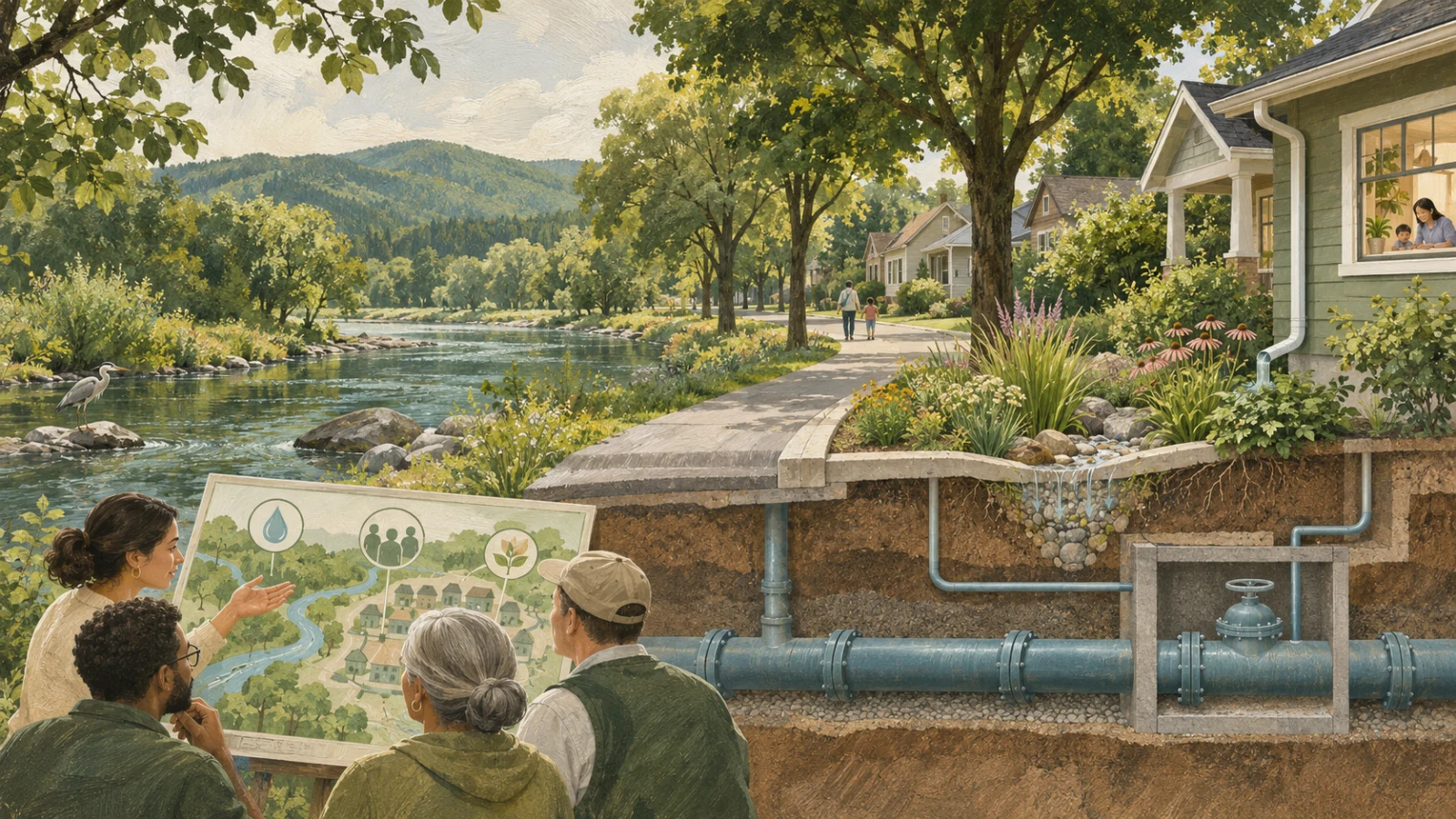
Google updated its water stewardship commitments on November 19, 2026, listing more than $100 million in funding it has announced this year for water sources, infrastructure and access across fourteen US states. It says it has committed more than $500 million to water, wastewater and reuse infrastructure over time in communities where it operates or builds data centres. The five commitments include replenishment, local infrastructure, cooling choices, disclosure and alternatives to fresh water. Several elements were already public earlier in the year. The November page adds to a continuing list of projects and says Google is evaluating more than 700 proposals from its request for information. Google's November update · June reporting on the framework
For someone who lives down the road from a data centre, the programme's meaning is more specific. Water needs to arrive with adequate pressure, get treated and stay affordable. Rain that once soaked into ground has to go somewhere when that land is developed. An annual company total can show progress across a portfolio. A household also needs to know what happens to its own river, utility and street. Google's updated list makes some of those connections visible. The most useful next step is to follow the individual projects through the public bodies and local organisations expected to deliver them.
Start at the public water main#
Fort Wayne City Utilities has a page for the East Transmission Main, last updated in October, explaining a roughly 22,000-foot, 30-inch pipe under construction toward the Adams Center Road corridor. The utility says Google fully funds it. The main is designed to add distribution capacity, strengthen redundancy and create public connections at four existing locations. According to the utility, it replaces a main the system had already planned to build, leaving those planned utility dollars available for other neighbourhood infrastructure. This is a specific construction project with a named payer and an account of the public use it is meant to serve. Fort Wayne's project description
The utility's frequently asked questions put the main's construction cost at $14 million. Once inspection and acceptance are complete, the asset becomes part of the public system, owned and maintained by City Utilities. The FAQ describes how customer rates pay the continuing costs of treatment, maintenance and eventual replacement. It says large customers pay more toward those operations through water use. A resident can therefore ask two linked questions. Has the developer paid for the new connection, and will the operation's revenue cover its share of keeping the public system working? The construction cheque has an immediate purpose. The service relationship has a much longer life. City Utilities' transmission main FAQ
The city's broader data-centre FAQ says the project will not raise other customers' rates. It explains the claim by pointing to standard rates and connection charges, the infrastructure funded by Google and the way additional customers can spread fixed costs. That is the utility's account of the arrangement. Future rate filings and operating records will allow residents to see whether it performs as described. A household that wants reliable water benefits if new industrial revenue supports useful infrastructure. It still needs the same care over maintenance, capacity and budgeting that the utility owes its established streets. Fort Wayne's data-centre information page
This pipe is part of the local setting for the water commitments, with its own timeline and construction purpose. The reuse project Google lists for Fort Wayne in the November update is another piece of work. In August, local station WPTA reported a $1.1 million contribution for improvements at Three Rivers Filtration Plant. The utility told the station that better handling of lime residuals from drinking-water softening would let it reuse more water before sending residual material to the biosolids facility. It projected withdrawals from the St. Joseph River could fall by about 180 million gallons a year. Those are estimated benefits from a project, attached to a date and a treatment process. WPTA's August reporting
What a resident can measure#
An annual estimate can make a project large enough to understand. The same WPTA report quoted City Utilities estimating about $150,000 a year in savings from treating, pumping and moving less water. If the work delivers, it can reduce what the system needs to take from the river and spend in operations. The useful follow-up is a completion date, a consistent period of metered withdrawals and a calculation that explains changes in demand or weather. A quiet year of pumping less would provide a much stronger account than the amount on the grant announcement alone. For the household, any savings enter a utility that has other costs to meet as well. Utility estimates reported by WPTA
Local reporting has already asked how these different obligations fit together. A September article from Pressure Points examined who would maintain the public assets after Google funded construction and set out records it would want to see on lifetime costs. It acknowledged the public main's named construction payer and the utility's stated wider benefits. Its questions included operations, replacement and the assumptions behind expected savings. That is a useful example of scrutiny that can continue after an announcement. A project might be good for the public and still deserve a clear account of the bills that arrive later. Pressure Points' local infrastructure analysis
Imagine the utility publishing a year's comparison after reuse equipment has been operating. The total intake can be lower, even as the number of customers grows. To understand it, residents need the period, the volume treated and an explanation of other changes to demand. Energy costs can change too. A manager who states both the measured reduction and the limits of the comparison helps the public see a real result. A local project can earn support through that ordinary record, without a resident having to take the company's broader environmental claims on trust. The account can also show where the original estimate needs revising.
Consider a family in a neighbourhood that has waited for work on its own pipes. A developer paying for a main that was already in the utility's plans can free up resources. It might allow another project to move sooner or help the system serve more users reliably. The family would be able to see that in the next capital plan, construction schedule or budget discussion. It cannot read its own next bill from the length and diameter of a new pipe. Capacity, revenue, operating costs and the timing of other improvements have to meet somewhere in a public financial account. The utility is the organisation that can connect them.
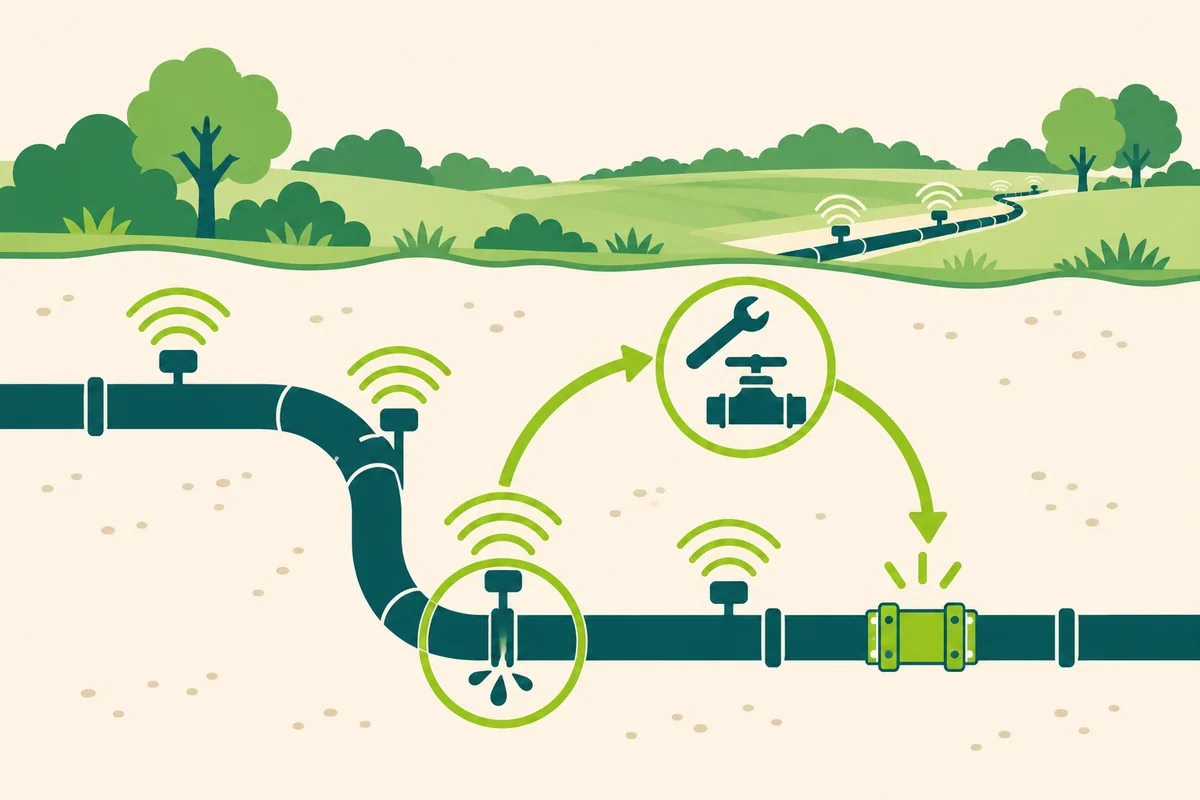
The same reasoning applies to a leak. A sensor can find a fault earlier, but water savings depend on how quickly the leak is confirmed and repaired. Nebraska Public Media reported a $3 million Google grant for Omaha's Metropolitan Utilities District to expand acoustic detection across 500 miles of high-priority lines. The utility's quoted estimate was that the completed system could save as much as a billion gallons annually. It is a prospective range from a provider, useful for understanding the intended scale. Repair logs, actual losses and the performance of the system over a common period would show how much of it the community receives. Nebraska Public Media on the detection project
A rain garden is another kind of service#
The Huron River Watershed Council describes a local programme that brings residents into the work directly. Rain Catchers Collective encourages rain gardens and rain barrels, with property assessments, public education and support for wider installations. HRWC identifies Google, through the Bonneville Environmental Foundation, among its funders, alongside the DTE Foundation and Americana Foundation. The programme aims to capture stormwater closer to where it falls. Somebody considering a garden gets a practical question: can the space beside a driveway or roof drain intercept runoff before it goes into the waterway? A neighbourhood gets a different question about how many suitable sites can actually be installed and maintained. HRWC's Rain Catchers programme
HRWC's description includes work with municipalities on larger public rain gardens and training people who can install and maintain green infrastructure. That is a continuing service, with assessments, design and people needed to look after the plants and flow paths. A landscaped patch that receives runoff can help water enter the ground and reduce the direct path of pollutants to the river when it is designed for its site. The gain depends on the soil, the flow that reaches it and whether it keeps functioning. Those are things a resident and local programme can observe together. They connect a grant to something within walking distance of the household. HRWC on growing the programme
Access to that service can matter as much as the design. A free initial assessment can help someone work out whether their plot is suitable before committing money or digging. For a public installation, residents can see which part of a park or road will be used, what maintenance will involve and who to contact if water starts going the wrong way. That makes the work legible to the people expected to live with it. The project becomes easier to support when the account includes an owner after installation as well as a sponsor at the start. These are small details in a programme and large details on a street.
The organisation also publishes concerns about the footprint of data centres in its watershed. On its data-centre page, it says its technical staff submitted comments in June on the wetland permit application for a proposed Google site in Van Buren Township. The page raises questions about loss of wetlands, stream changes, stormwater and habitat. It also discloses the grant associated with the water stewardship programme and states that its watershed advocacy continues. Its position is a practical reminder that a useful local project and a proposed development can be judged on their own terms. Funding a rain garden can support a resident while an organisation still asks what happens to nearby wetlands. HRWC's data-centre and wetland account
For the people beside a stream, the distinction is physical. A green installation on one site works on the water that reaches it. A wetland on another site may take water during storms, sustain a different habitat and connect to the river at a different place. A decision about either one needs its own map and expected performance. The existence of one project can make a contribution valuable without completing the evaluation of the other. Community scrutiny becomes more precise when the funding and the land-use proposal are available in records that readers can compare. The people who use the river can then ask for the evidence that applies to their part of it.
What replenishment adds up#
Google's November update says it replenished more than seven billion gallons in 2025. Its environmental report gives a more detailed company figure of about 7.7 billion gallons and says that equalled roughly 78 percent of its freshwater consumption. The report describes a portfolio of 165 projects across 97 watersheds. Its stated 2030 ambition is to replenish 120 percent of the freshwater consumed on average across its offices and data centres. This is an account of company-wide progress and a future goal. A resident still needs the location, timeframe and water problem behind each project to understand the local effect. Google's November account · Google's 2026 environmental report
The company estimates that its portfolio, once fully implemented, could replenish more than nineteen billion gallons annually by 2030. It had already published that portfolio estimate earlier in 2026. Time to completion and performance remain important. A project can be selected, permitted, built and finally operating across several different years. Rainfall or soil conditions can change what an intervention achieves. A target recorded against a future year helps organise the work. Comparing it with the delivered volume for the last completed year helps the public see how much of the expected result is still ahead. Google's March portfolio update
Replenishment also needs a definition at the project level. An intervention might conserve water that would otherwise be withdrawn, improve infiltration or restore a flow useful to an ecosystem. Each has a baseline from which its benefit is estimated and a period over which it is counted. The World Resources Institute's water-benefit guidance starts with local catchment conditions and calls for defensible methods, conservative assumptions, appropriate timeframes and attribution that avoids counting a benefit twice. That gives readers a way to examine a corporate total. They can ask what changed, how it was measured and which share of the result belongs to the funding being described. WRI's water-benefit accounting guidance
Water quality has its own place in that account. A project can reduce pollutants reaching a stream without supplying a new gallon of drinking water to a household. Another intervention can provide both a volume and a quality benefit. WRI's paired guidance treats the two as related outcomes with different ways to quantify them. Residents use both. The people responsible for a treatment plant may value cleaner incoming water, while neighbours near a stream may care about flood behaviour or fish habitat. Those outcomes can be described directly, alongside the volumetric figure. A round-number total can become more meaningful when people can see the distinct effects that went into it. WRI on measuring quantity and quality benefits
The season matters#
There is also a difference between a year's water account and a difficult week. A community's need can be most acute when a river runs low or when a major storm sends too much runoff toward homes. A conservation project with a large annual estimate could deliver most of its benefit in a season that does little to relieve that specific pressure. A well-timed smaller intervention could matter more at the point the utility needs it. Matching the timing of use and benefit helps explain what local protection means. It also makes an annual goal more useful than a national comparison between unlike kinds of water use.
Google says it assesses watershed conditions before choosing cooling for new sites, considering water cooling where resources are healthy and resilient, and using air cooling or recycled water in places it assesses as high risk. Cooling decisions involve energy as well as water. The document gives the company's policy, and its site-level disclosures can show the resulting use. A local authority still needs to look at the source, capacity, seasonal permissions and conditions under which the operator is allowed to draw. That is where a general commitment becomes a decision about an actual facility and the same water system that serves its neighbours. Google's cooling and disclosure commitments
The company cites Douglas County, Georgia, as an example of working with a water and sewer authority to use treated wastewater for cooling. Reuse offers an additional source for a particular industrial job, depending on the water's treatment and the facility's design. A project of that type asks questions about continuity of the supply, treatment requirements, backup arrangements and where water goes afterwards. Residents gain when their utility can explain those arrangements in understandable terms. A reference to reclaimed water begins that discussion. Details about how much, when and from which part of the system give it local meaning. Google's description of the Douglas County example
Funding needs a timetable#
The more than $100 million described as announced this year is a programme-level amount. The more than $500 million described as committed to infrastructure over time is another total with a different scope and period. A reader comparing the figures should also look for the individual contract, the project schedule and the record of payment and completion. Some money supports a utility's physical assets, some supports conservation or habitat and some funds public access or education. The effect is clearer when the programme says what an amount is meant to buy. A dollar committed to a project and a functioning piece of infrastructure sit at different stages of the same process. Google's funding and project list
Virginia reporting demonstrates how those promises are received. Augusta Free Press reported a new $10 million state commitment on November 19 and questioned its size alongside Google's data-centre spending. That is the publication's critical assessment. The amount alone cannot establish the harm a development causes or the benefit of a water project. The comparison does show a community-facing concern that a company may encounter: residents want commitments large enough to address real needs, with an account of what those needs are. The details of a wetland enhancement or the work across housing units can be tested by what the projects deliver. A ratio to total corporate investment answers a different question. Augusta Free Press commentary
The November Google update also describes reviewing more than 700 proposed projects. Its request for information invited utilities, local governments, nonprofits, companies and Tribal governments to submit interventions in specified areas. Selection is one step before a partner can plan and deliver the work. For an applicant, publication of awards and practical reporting expectations will matter. For a nearby household, it is useful to know which projects were selected for its watershed, how they compare with local priorities and when there should be a result to inspect. A long list of proposals can be encouraging, provided later announcements make clear how the list turns into completed work. Google's water project request for information · November review update
The public record that lasts#
Fort Wayne's pipe and treatment work, Omaha's leak detection and the Huron River's rain gardens all lead to a similar kind of follow-up. There should be a project, someone responsible, a date to examine and a measure tied to the need. For a utility, the next stage might be acceptance of an asset or a report of metered savings. For a habitat or stormwater project, it might be observed water quality, continued maintenance or a record of how a site performs in wet weather. Google's annual report can sit beside those local records, allowing a reader to see which project contributes to the total and what its community receives.
That record is also valuable after the company has left the opening event. A water main will need work years later. An installation in a public garden needs people who know how it was designed to drain. A resident who buys a home near a development should be able to find the obligations governing the water connection and a history of its use. The website announcing a grant can be an entry point. The authority or programme doing the work needs to remain the place where decisions, budgets and outcomes can be followed over the life of the asset.
Google's updated commitments offer several concrete routes to local benefit. They also put a company total next to decisions that remain intensely local. A pipe that improves reliability, a repair that keeps treated water in the system and a rain garden that keeps working can all matter to a household. Their value will be demonstrated by the service, the river and the bills over time. Communities can welcome the investment and still expect the evidence that follows it from announcement to operation. That is how a water promise reaches someone on the other side of the tap.